
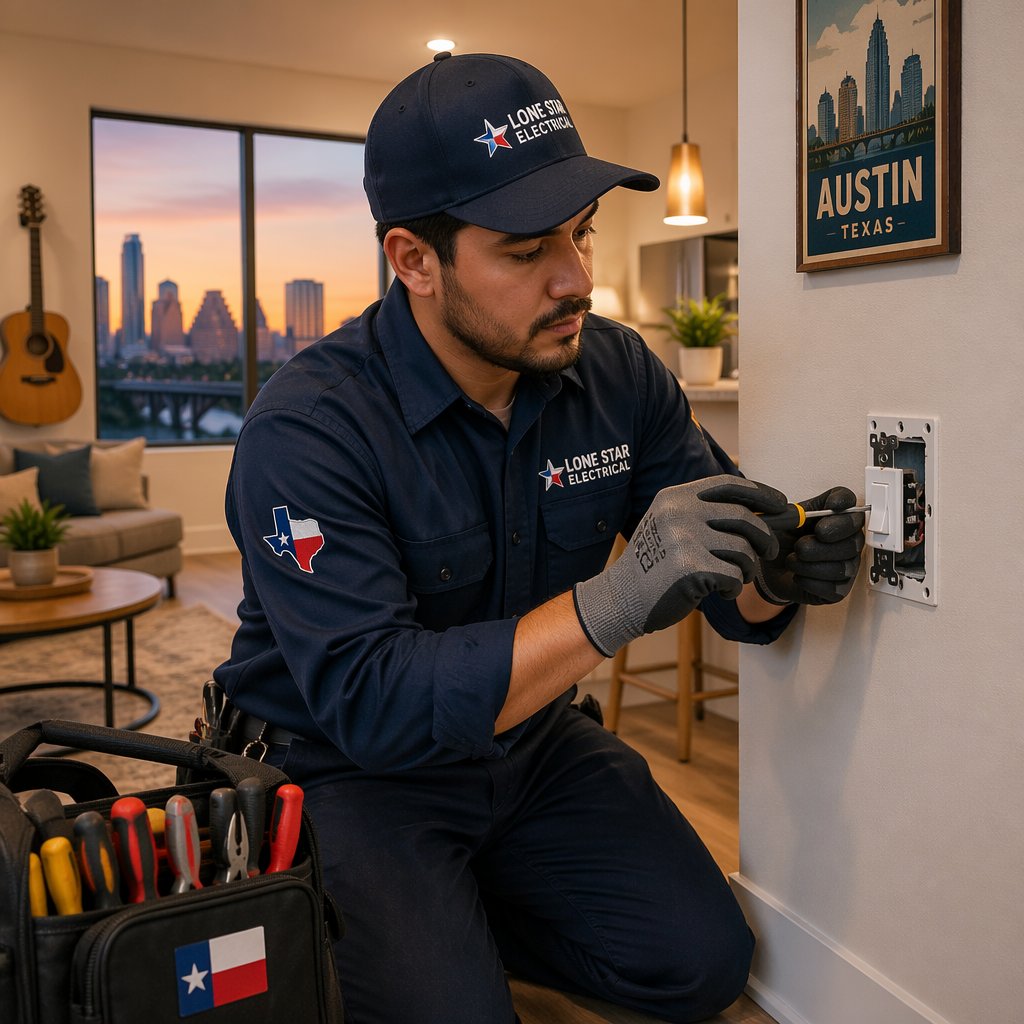
If your switch sparks, sticks, or just won’t stay on, you need a quick, safe fix. Magnify Electric’s licensed electricians handle any light switch problem for homes and businesses across Central Texas, from basic swaps to smart-home upgrades.
Let’s talk about how to spot common switch issues, when to try a quick DIY, and when it’s time to call in the pros. Our crew works on automated lighting, ceiling fans, Lutron systems, EV chargers, outdoor lighting, outlets, recessed lights, panel upgrades, surge protection, wiring, generators, smoke/CO₂ detectors, and more—serving Spicewood, Austin, Bee Cave, Lakeway, Dripping Springs, Georgetown, Leander, Round Rock, Kyle, Cedar Park, Liberty Hill, Westlake, The Hills, Briarcliff, Horseshoe Bay, Sunset Valley, Hutto, and nearby spots.
Count on our licensed team for fast troubleshooting, safety checks, commercial lighting, smart home setups, and emergency help—so your lights just work, the way they should.
Understanding Light Switch Repair in Austin TX
Let’s get into how to spot a bad switch, what types you’ll find around Austin, and why fixing things fast matters. Repairs can be as simple as swapping out a switch or as involved as rewiring or adding smart controls.
Common Signs of a Faulty Light Switch
If your switch feels loose, sparks when you flip it, or buzzes, stop using it and get it checked. Flickering lights, lights that won’t turn on, or switches that get hot are signs of worn contacts or loose wiring.
Tripped breakers tied to a specific switch or a burning smell near the plate? Those usually mean a short circuit or overheating. Get a licensed electrician to check the switch, wiring, and nearby connections to find out what’s really going on and avoid a fire risk.
Types of Light Switches in Austin Homes
Most homes have standard single-pole switches for one light in one spot. Three-way and four-way switches let you control a light from two or more locations—super handy for hallways and stairs.
You’ll also spot dimmers, smart switches (Wi‑Fi or Lutron), rocker switches, timers, and motion-sensor switches in plenty of Austin homes. Smart and Lutron systems let you set up automated lighting scenes and remote control, but they need the right wiring and setup, which our licensed electricians handle all the time.
Why Timely Repair Is Important
Putting off a repair can turn a small issue into a big, expensive, or even dangerous one. A bad switch can burn wiring insulation, damage fixtures, or create shock and fire hazards if ignored.
Getting it fixed quickly brings your lighting back and keeps your place safe. Our licensed electricians cover everything from smart lighting and EV charger outlets to surge protectors, panel upgrades, and emergency repairs across Austin, Bee Cave, Lakeway, Dripping Springs, Georgetown, and other Central Texas towns. You’ll get safe, code-compliant work, whether it’s a quick swap or a bigger upgrade.
Steps to Diagnose Light Switch Problems
Start by making sure it’s safe, then test the switch, check the wiring, and look at the circuit. Watch for flicker, buzzing, heat, or a loose switch, and decide if you need to call a licensed electrician.
Safety Precautions Before Inspection
Flip off the circuit breaker for the switch you’re checking. Use a non-contact voltage tester to make sure the power’s really off before you touch anything.
If you have them, wear safety glasses and insulated gloves. Stand on something dry and stable, and keep kids and pets clear.
If the switch feels warm, sparks, or trips breakers when you flip it, leave the power off and don’t mess with it. That’s a sign you need a pro.
Grab basic tools: screwdriver, flashlight, needle-nose pliers, and a multimeter if you have one. Label wires or snap a photo before disconnecting anything—seriously, it saves headaches.
Troubleshooting Electrical Issues
Start simple: tighten the bulb or swap in a working one. If the light still flickers, flip the switch while watching and listening for buzzing.
Take off the switch cover and check for loose wires or burned spots. Use a multimeter to test for continuity with the switch on and off; if it doesn’t show continuity when “on,” the switch is probably bad.
Check the breaker and any GFCI outlets on that circuit. Reset tripped breakers and try again. If more than one fixture or outlet has issues, you might have a wiring or panel problem.
Signs of overload—like frequent breaker trips, dimming lights when big appliances run, or scorch marks—mean it’s time for a licensed electrician.
When to Call a Professional Electrician
If you see charred wires, melted insulation, or a hot switch, call a licensed electrician right away. That’s not something to wait on.
Call in a pro if breakers keep tripping, multiple circuits are acting up, or you need a panel upgrade for new devices. Don’t try big wiring or panel changes yourself.
Bring in a licensed team for smart home installs, EV charger wiring, surge protection, or commercial lighting upgrades. Magnify Electric’s electricians cover Spicewood, Austin, Bee Cave, Lakeway, Dripping Springs, Georgetown, Leander, Round Rock, Kyle, Cedar Park, Liberty Hill, Westlake, The Hills, Briarcliff, Horseshoe Bay, Sunset Valley, Hutto, and nearby Central Texas towns. We handle everything from simple swaps to upgrades, automated lighting, ceiling fans, Lutron systems, EV charging, outdoor lighting, outlets, recessed lighting, TV installs, wiring, panel work, troubleshooting, generator hookups, smoke and CO₂ detectors, and more.
Professional Light Switch Repair Services in Austin TX
Get clear, fast repairs from licensed electricians—whether it’s a quick fix or full troubleshooting. Expect honest pricing, safety checks, and options for smart upgrades or related work.
What to Expect From a Repair Appointment
When you call, someone confirms your address in Austin or a nearby town and gives you a time window. A licensed electrician shows up in a marked vehicle, with tools and common switches, and checks that it’s safe before starting.
They inspect the switch, wiring, and circuit. They’ll test voltage, tighten or replace connections, and check the outlet or fixture. If it’s a bigger issue—like a panel or breaker problem—they’ll explain what’s going on and what’s next.
You’ll get a clear estimate before any extra work. If you want, they can install dimmers, timers, or smart switches like Lutron. Before leaving, they clean up and show you the repaired switch.
Cost Factors for Light Switch Repair
Price mostly depends on the switch type, wiring, and how easy it is to reach. A basic single-pole switch swap costs less than a dimmer, multi-location, or smart switch. If there’s damaged wiring, loose neutrals, or code stuff to fix, expect it to cost more.
Labor rates change based on when you call and if it’s an emergency. Adding smart features, Lutron, or running new wires bumps up the price more than a simple switch. Panel work, surge protection, or EV charger circuits mean extra materials and permits.
Magnify Electric gives written estimates and explains the charges, so you know what you’re paying for—whether it’s a basic repair, upgrade, or bigger job.
Choosing a Qualified Local Electrician
Pick a licensed electrician who knows residential and commercial wiring, smart home systems, and safety checks. Ask to see their license, insurance, and some recent local references—maybe from Spicewood, Bee Cave, or Round Rock.
Choose a crew that actually does what you might need: ceiling fans, recessed lighting, outlet repairs, EV charging, outdoor lighting, panel upgrades, surge protectors, generator hookups. Make sure they pull permits, follow code, and offer emergency help.
Magnify Electric serves Austin and Central Texas with licensed electricians for both small jobs and big upgrades. You’ll get clear communication, on-time arrival, and follow-up if you need it.
DIY Light Switch Repair Tips
Turn off the right breaker and double-check the power’s off before you start. Grab the right tools, follow safe wiring steps, and avoid mistakes like loose connections or putting wires in the wrong place.
Tools Needed for Basic Repairs
- Screwdrivers (flat and Phillips) — for plate and switch screws
- Voltage tester or non-contact tester — to make sure the circuit’s dead
- Wire stripper/cutter — to trim and prep wires
- Needle-nose pliers — to bend and hold wires
- Electrical tape and wire nuts — for safe splices and insulation
- Replacement switch (single-pole, 3-way, or dimmer) — match the old one
Wear safety glasses and insulated gloves if you’ve got them. Always shut off the breaker and, if you can, lock or tag it. Test the switch screws and wires before touching anything. If you see aluminum wiring or corrosion, stop and call a pro.
Step-by-Step Guide to Replacing a Switch
- Turn off the breaker and check with your voltage tester.
- Remove the wall plate and unscrew the switch.
- Note where each wire goes—take a photo if that helps.
- Loosen screws and disconnect wires. If they’re pushed into the back, cut and strip about 3/4″ of insulation.
- Attach wires to the new switch: hot to brass or marked, neutral/ground to their spots. Tighten screws.
- Tuck wires back, secure the switch, put the plate back, and turn the breaker on.
- Test the switch and any 3-way function. If it hums, sparks, or trips the breaker, cut the power and call a licensed electrician.
If you get stuck, Magnify Electric’s licensed electricians install and repair switches quickly and safely for homes and businesses around Austin.
Avoiding Common Mistakes
Don’t skip the voltage test. People get in trouble by guessing the breaker is off—always check.
Match the switch to the wiring. Swapping a 3-way for a single-pole will break the other switch. Label wires or use your photo so you don’t mix up travelers and grounds.
Tighten screws well—loose ones cause heat and flicker. Don’t over-strip wire; you want enough under the screw for a solid clamp. If you spot burnt insulation, melted plastic, or a switch that moves around, stop and call for help.
Magnify Electric has licensed electricians for tricky or risky jobs—panel upgrades, smart home systems, EV chargers, outdoor lighting, surge protection, and emergency help across Central Texas: Austin, Bee Cave, Lakeway, Round Rock, Georgetown, Leander, Cedar Park, and nearby towns.
Upgrading Light Switches in Austin TX
Upgrading your switches can make life easier, save energy, and keep your place safer. Want to know how smart switches, energy-saving upgrades, and code updates affect cost and function? Let’s dig in.
Smart Switch Installation Benefits
Smart switches let you control lights from your phone, with voice assistants, or on schedules. You can set up scenes for different rooms, dim lights automatically, and even link switches to motion sensors to cut energy use when rooms are empty.
You’ll usually need a neutral wire and proper wiring, especially for dimmers or Lutron systems. Our licensed electricians handle Lutron smart home systems, automated lighting, and compatible switches so everything works together. We cover single and multi-switch setups—3- and 4-way circuits for hallways, staircases, you name it.
They also boost security. Set your lights to turn on and off while you’re away to make it look like someone’s home. If you want remote control or device integration, we’ll install and test the whole system so it actually works like it should.
Energy Efficiency Upgrades
Switching to LED-compatible dimmers and smart controls cuts electricity use and lowers bills. Dimming and motion-based control help stop wasted light in garages, closets, or outdoor areas where lights get left on by accident.
Upgrades can include timer switches, occupancy sensors, and scene controls for whole rooms. We install energy-saving features for homes and businesses—think recessed lighting controls and outdoor timers that follow sunset.
You’ll notice payback faster if you pair efficient bulbs with smart scheduling. We also offer surge protectors and panel upgrades to handle new devices safely, avoiding overloads and helping your lighting last longer.
Local Codes and Compliance
Austin and surrounding cities require licensed work for most switch upgrades and new wiring. You’ve got to follow rules for grounding, neutral wires, and GFCI protection in places like kitchens, garages, and outdoor circuits.
Our electricians know the codes in Spicewood, Bee Cave, Lakeway, Dripping Springs, Georgetown, Leander, Round Rock, Kyle, Cedar Park, Liberty Hill, Westlake, The Hills, Briarcliff, Horseshoe Bay, Sunset Valley, Hutto, and all over Central Texas. We pull permits and handle inspections so your project passes the first time.
Whether you’re swapping out a single switch or tackling a full lighting upgrade in a commercial space, you’ll get work that meets safety standards. Magnify Electric covers everything from outlets and ceiling fans to panel upgrades and emergency repairs.
Preventing Future Light Switch Issues
Keep switches clean, tight, and protected from surges to avoid issues down the road. Regular checks and surge protection prevent most failures and keep your home or business safer.
Routine Maintenance Advice
Check your switches every 6–12 months for looseness, warmth, or buzzing. Always turn off power at the panel before tightening terminals or replacing a faceplate. If a switch feels hot or sparks, stop using it and call for service.
Use a flashlight and a non-contact voltage tester to make sure power’s off before you touch any wiring. Replace worn toggles, dimmers, or plastic covers to avoid poor connections. For smart switches, keep firmware updated and make sure Wi‑Fi is strong nearby to keep things running smoothly.
Schedule a full electrical inspection every few years, especially if your house is older. Electricians can spot hidden wiring issues, loose neutrals, or overloaded circuits that cause switches to fail over and over.
Protecting Switches From Power Surges
Put a whole-home surge protector at your main panel to block big voltage spikes from storms or the grid. Add surge strips for sensitive devices and smart switches that need steady power.
During severe storms, unplug or turn off sensitive lighting and smart devices if you can. If you notice frequent surges, have an electrician check your grounding and bonding—bad grounding lets surges hit your switches and appliances.
Magnify Electric’s team installs and tests surge protection and grounding for homes and businesses around Austin and nearby towns. You can call us for panel upgrades, surge protectors, smart home wiring, EV charging, outdoor and recessed lighting, and emergency repairs.
Frequently Asked Questions
You probably want to know who to call, how to spot bad switches, DIY limits, repair times, and what things cost in Austin. Here’s what you need to know, who to call, and what to expect.
Who are the best local electricians for light switch issues?
Magnify Electric’s licensed electricians handle everything from simple switch swaps to panel upgrades and smart-home installs for both homes and businesses. We cover Spicewood, Austin, Bee Cave, Lakeway, Dripping Springs, Georgetown, Leander, Round Rock, Kyle, Cedar Park, Liberty Hill, Westlake, The Hills, Briarcliff, Horseshoe Bay, Sunset Valley, Hutto, and all over Central Texas.
Our team handles automated lighting, ceiling fans, Lutron systems, EV charging, outdoor and recessed lighting, surge protectors, wiring, and emergency repairs. We also do safety inspections, commercial lighting, and smart home setups.
How can I troubleshoot a faulty light switch in my home?
Flip off the circuit breaker before you touch anything. Check the bulb first, then look at the fixture and wiring if the bulb isn’t the issue.
Try swapping the switch cover and test the switch once power’s back. If lights still flicker or breakers trip, stop and call a licensed electrician.
What are common signs that a light switch needs repair?
Watch for flickering lights, a burning smell, or a switch that feels hot. Those usually mean damaged wiring or a failing switch.
Other red flags: a switch that won’t click or stays loose, frequent circuit trips, or lights that work only sometimes.
Are there any DIY tips for fixing a light switch?
You can do basic stuff like testing the bulb or tightening a loose faceplate, but always turn off the breaker first. If you know how, use a non-contact voltage tester to double-check power’s off.
Don’t mess with wiring or try to fix damaged wires yourself. Call a licensed electrician for anything involving wiring, three-way switches, smart-home setups, or anything that touches the circuit.
How long does a typical light switch repair take?
Most simple switch swaps take 15–30 minutes after you turn off the breaker. Trickier jobs like three-way switches, smart switch wiring, or tracking down weird faults can run 1–2 hours.
Bigger upgrades, panel work, or commercial installs take longer—it really depends on what you need done.
What’s the average cost of light switch repair in Austin?
Basic switch replacement? That’s usually on the cheaper end—think a straightforward service fee, maybe a few bucks for parts, and you’re set. If you’re just swapping out an old switch for a new one, it shouldn’t break the bank.
But things get trickier (and pricier) when you’re dealing with stubborn wiring, three-way switches, or you’ve got your heart set on smart-home features. Need a panel upgrade? That’ll cost more too. It’s best to reach out to a licensed electrician in Austin for a real quote—especially if you’re in a hurry or something’s not working right.