
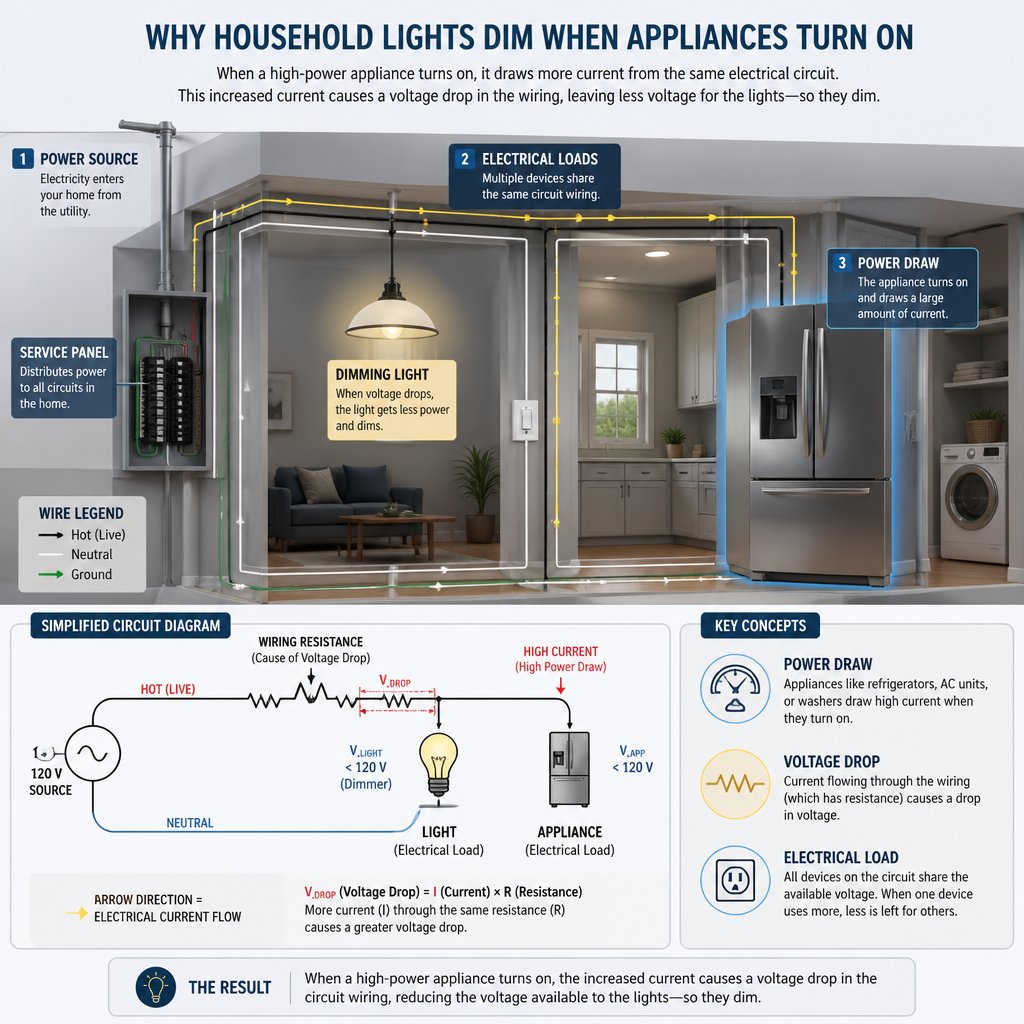
When your lights dim as appliances turn on, it’s usually because those devices demand a quick surge of power. Things like refrigerators, microwaves, air conditioners, or washers pull extra current right at startup, and your lights may dip for a second as the system catches up.
A quick, mild dim is often normal. But if the dimming is strong, frequent, or getting worse, it might mean an overloaded circuit, a loose connection, or even a bigger electrical issue. Paying attention to when and where it happens can tell you a lot.
If you notice a quick flicker, that’s one thing. But if your lights sag every time a big appliance kicks on—or if it happens across multiple rooms—it’s worth a closer look.
What Brief Dimming Usually Means
Short dimming often means an appliance just created a sudden load on your electrical system. That startup rush can cause a small voltage drop, especially with compressors or motors.
If your lights bounce back right away and it only happens with one heavy appliance, it might be nothing to worry about. But if it gets worse, lasts longer, or spreads to more lights, your system could be struggling.
Normal Startup Power Draw
Many appliances need a burst of extra power when they start. Compressors, pumps, and motors do this a lot.
A fridge, AC, or microwave can cause a quick dip, especially in nearby lights. That’s pretty common in lots of homes.
When Short Flickers Become a Warning Sign
The story changes if dimming is strong, frequent, or seems random. That might mean the circuit’s near its limit or something’s loose.
If lights dim in more than one room, or you hear buzzing, smell warmth, or spot other odd behavior, the issue needs attention. Those aren’t just startup quirks.
Appliances That Commonly Trigger Voltage Drops
Some devices are just more likely to cause dimming because they draw a lot of power right at startup. Cooling equipment, laundry machines, and big kitchen appliances are usual suspects.
Commercial spaces run into this too when big equipment starts up together. More demand means you’re more likely to notice a dip.
Air Conditioners and Refrigeration Equipment
ACs and fridges use compressors that need a hefty startup surge. That’s why the lights often dip when the AC kicks on or the fridge cycles.
If it’s brief and mild, that’s probably fine. But if it’s strong every time, your circuit or service size might just be too small.
Laundry and Kitchen Machines
Washers, dryers, dishwashers, garbage disposals, and microwaves can all make the lights dip. Kitchens are especially prone to this because so many appliances share circuits.
If your lights dim when you run the microwave and something else, the circuit may be overloaded. That usually means it’s time to check the wiring layout.
High-Demand Commercial Equipment
In commercial buildings, big HVAC units, refrigeration banks, and shop equipment can cause bigger dips than household stuff. When several machines start at once, the effect can spread through the building.
That kind of dimming can point to service limits, panel issues, or a need for better load balancing. It’s worth checking before it turns into a bigger headache.
Electrical Issues That Can Be Behind the Problem
Not every dim light is caused by a hungry appliance. Sometimes the real problem is the wiring, circuit design, or the building’s electrical service.
These issues usually show up as repeated dimming, not just a one-off dip. If lights react to everyday appliance use, the system might need some work.
Undersized or Aging Circuits
Older homes and buildings weren’t built for today’s electrical demand. A circuit that was fine years ago might be too small now.
If the wiring’s old or the circuit was never sized right, even normal appliance startup can make lights dim. I see this a lot in homes where people added new appliances but skipped electrical upgrades.
Loose Connections and Failing Components
Loose wires, worn breakers, bad switches, and aging receptacles can all make voltage drop when there’s a load. These issues often cause dimming that comes and goes.
A loose neutral is especially sneaky—it can make lights act weird in multiple rooms. That’s not something to ignore.
Overloaded Panels and Service Limits
If too many appliances share the same panel, the system can struggle at startup. This is common in homes with added equipment or businesses with growing needs.
When the service size is too small, the whole electrical system can sag under heavy demand. That’s a sign you might need a panel or service upgrade.
Safety Risks You Should Not Ignore
Some dimming is harmless, but sometimes it points to a problem that can damage wiring or equipment. The risk goes up if it’s frequent or severe.
If dimming comes with heat, noise, burning smells, or visible damage, pay attention. Those are warning signs, not just quirks.
Heat Buildup Inside Wiring and Devices
Loose or overloaded connections build up resistance, and resistance makes heat. Over time, that heat can damage outlets, switches, breakers, and insulation.
If a light dims and a switch plate or outlet feels warm, stop using that circuit and have it checked. Heat means something’s wrong.
Signs of Arcing or Service Damage
Arcing happens when electricity jumps across a bad connection. You might hear crackling, buzzing, smell burning, or see lights flicker sharply when an appliance starts.
If dimming comes with sparks, repeated breaker trips, or visible panel damage, call a licensed electrician now. The problem could involve service equipment that needs fast repair.
How a Licensed Electrician Diagnoses the Cause
A licensed electrician checks the whole system—not just the dim light. They want to know if it’s normal startup demand or a real problem.
They’ll test the load, review the panel, and see how circuits are distributed. That helps figure out if a repair will do the trick or if you really need an upgrade.
Load Testing and Voltage Evaluation
The electrician measures voltage while appliances start and run. That shows if the dip is minor or outside the normal range.
A meter test can reveal if dimming is tied to one appliance or happens system-wide. That makes diagnosis much more accurate.
Panel Inspection and Circuit Review
A panel inspection shows if breakers, neutral connections, and wiring are in good shape. The electrician also checks how loads are split across circuits.
I like this part because it often explains why one room acts up and another doesn’t. The panel layout tells a story.
Repair Versus Upgrade Recommendations
Sometimes the fix is simple—tighten a connection, swap a worn device, or move a load to another circuit. Other times, you’ll need a panel upgrade, new wiring, or a dedicated circuit.
A good electrician will explain what fits your situation and why. That way, you solve the cause, not just the symptom.
Solutions for Homes and Businesses in Central Texas
If you’re in Central Texas, the right fix depends on whether the issue is just one circuit or the whole property. A good repair should boost safety, stability, and everyday comfort.
Magnify Electric handles residential and commercial electrical work in Spicewood, Austin, Bee Cave, Lakeway, Dripping Springs, Georgetown, Leander, Round Rock, Kyle, Cedar Park, Liberty Hill, Westlake, The Hills, Briarcliff, Horseshoe Bay, Sunset Valley, Hutto, and nearby Central Texas communities.
Targeted Repairs for Lighting and Outlet Problems
Sometimes, dimming comes down to a bad switch, loose outlet, failing fixture, or damaged wire. Targeted repairs can fix the problem without major work.
That’s where good troubleshooting matters. A solid repair stops the flicker, restores steady power, and helps prevent it from coming back.
Panel Upgrades Surge Protection and Wiring Improvements
If your system’s undersized, old, or overloaded, a panel upgrade might be the best call. Whole-home surge protectors and wiring improvements also help protect your gear and keep voltage steady.
These updates matter in homes with lots of modern appliances and in businesses with bigger loads. They also make things safer in the long run.
Smart Lighting EV Charging and Ongoing Electrical Support
Your electrical system should keep up with your needs. That might mean smart lighting, automated switches, ceiling fans, Lutron smart home systems, EV charging outlets, outdoor lighting, outlet upgrades, recessed lighting, TV installation, surge protectors, wiring, lighting installations, panel upgrades, troubleshooting, generator hookups, smoke and CO₂ detectors, and general electrical improvements for homes and businesses.
Magnify Electric is a solid choice because their licensed electricians handle both simple fixture swaps and bigger jobs like commercial lighting, safety inspections, smart home setups, and emergency repairs. It’s handy to have one team for routine work and larger upgrades.
Frequently Asked Questions
Is it normal for my lights to dim when the AC, fridge, or microwave starts up?
Yeah, a quick, mild dim is usually normal when a big appliance starts. That startup surge can cause a small voltage drop for a moment.
If the dimming is strong, frequent, or getting worse, have the system checked.
What electrical problems can cause lights to flicker or dim when a big appliance kicks on?
Common causes include overloaded circuits, loose wiring, old components, a failing neutral, or a panel that’s too small for the load. Sometimes, the appliance is fine and the wiring is the real problem.
A licensed electrician can test your system and find the source.
Could an overloaded circuit or panel be making my lights dim during appliance startup?
Absolutely. An overloaded circuit or panel is one of the top reasons for this. When too many devices share the same wiring or service, voltage can dip when a big appliance starts.
That’s a sign you might need a circuit change, panel work, or a dedicated line.
How can I tell if a loose neutral or bad connection is causing the dimming?
Loose or bad connections usually make lights act unpredictably. You might see dimming in more than one room, lights that brighten and dim oddly, buzzing, or issues that change when you use different appliances.
That kind of thing usually points to a wiring issue that needs a pro.
When should I call an electrician about lights dimming with appliance use?
Call an electrician if the dimming is frequent, strong, or getting worse. Also call right away if you notice heat, burning smells, sparking, breaker trips, or crackling sounds.
Those signs can mean a safety problem—not just a heavy load.
What simple checks can I do at home to reduce or troubleshoot the dimming?
Try checking if the light and the appliance share the same circuit. Maybe don’t run a bunch of big appliances all at once. Notice if the dimming only kicks in when you use a certain device—it might narrow things down. Sometimes it’s just a loose bulb or a finicky switch causing trouble, so give those a look too.
If the problem just won’t quit, it’s probably time to call in a professional.