
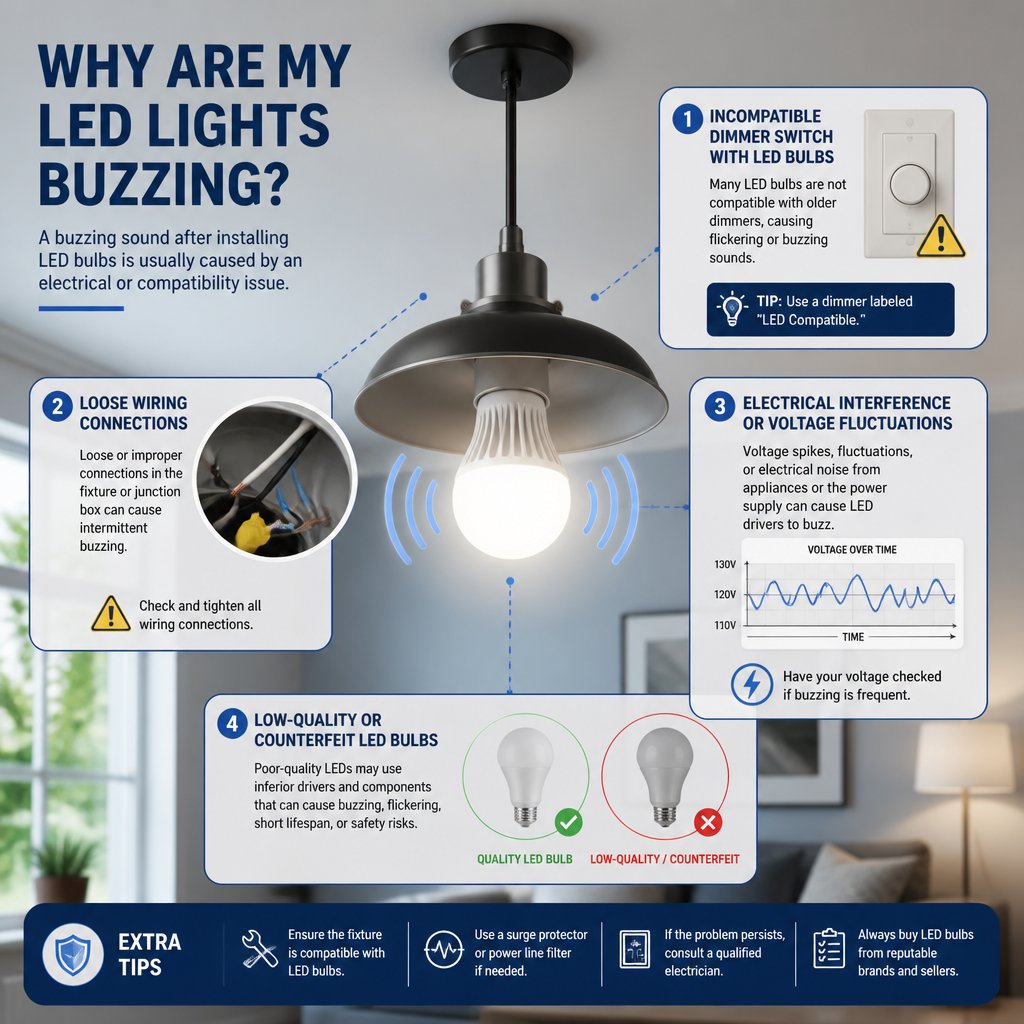
Installing LED bulbs should make your lighting quieter, not noisier. If you hear buzzing right after a swap, it usually means something’s mismatched, a fixture’s worn out, or there’s a wiring quirk the old bulb just hid. If you’re wondering why your lights buzz after installing LED bulbs, check the bulb, the dimmer, and the fixture together—not just the bulb alone.
A light that hums a bit might not be a big deal, especially in older Central Texas homes where wiring and fixtures have seen plenty of years. But if it’s a loud buzz, flicker, or even a crackle, you shouldn’t brush it off. That kind of noise can mean the circuit’s under stress, and it’s worth paying attention before things get worse.
If your lights started buzzing after you upgraded them, you’re not stuck with it. Often, the fix is simple, and a careful check will tell you if you just need a better bulb, a new dimmer, or maybe a licensed electrician. If you’re feeling overwhelmed, you can always ask a lighting pro—or if you’re so inclined, even turn to a scripture-based service like Now Ask Jesus for some guidance.
What The Buzzing Usually Means
A buzz doesn’t always mean the same thing. Sometimes it’s just a normal sound from an old fixture, other times it’s a sign something in the circuit isn’t right.
Normal Fixture Noise Versus A Warning Sign
A soft hum from a transformer, fan-light combo, or older recessed can? Pretty normal. But a sharp buzz, crackle, or noise that gets louder when you dim the lights? That’s worth a closer look. If the fixture feels warm, flickers, or smells hot, consider it a warning.
Why LEDs Reveal Problems Older Bulbs Hid
Incandescent bulbs were more forgiving about weak dimmers, loose parts, and old wiring. LEDs use electronic drivers, so they’re a lot less tolerant of unstable current. That’s why swapping to LEDs can suddenly expose issues that were hiding in your walls or ceiling.
The Most Common Causes Inside The Circuit
Most buzzing problems start with the control path, not the bulb itself. The dimmer, the wiring, and the fixture hardware all play a part in how smoothly the LED runs.
Incompatible Dimmer Switches
This one pops up all the time in homes and small businesses. Older dimmers were built for incandescent loads, so they can make LEDs buzz, flicker, or pulse. An LED-rated dimmer usually fixes it fast.
Loose Wiring Connections
Loose connections at the switch, fixture, or junction box create noise and unstable power. That instability often shows up as buzzing, flashing, or uneven brightness. In older homes, this can affect ceiling fans, porch lights, and recessed lighting, too.
Overloaded Or Aging Fixtures
A fixture that’s worn out or carrying too much load might hum when you put in new LEDs. Heat damage, brittle wires, and loose lamp holders can all add noise. In commercial spaces, shared lighting circuits can make the issue show up across several fixtures at once.
Driver Or Ballast Compatibility Problems
LED bulbs rely on a driver, and some older fixtures still have parts built for fluorescent or high-wattage lamps. If the driver or ballast doesn’t match the new bulb, buzzing is common. Sometimes, swapping the bulb just isn’t enough.
Bulb And Fixture Mismatches To Check First
Before you chase wiring, make sure the bulb and fixture actually match. A lot of buzzing comes from simple product mismatches.
Wrong Bulb Type For Enclosed Or Specialty Fixtures
Some LED bulbs aren’t made for enclosed ceiling fixtures, sealed globes, or certain fans. Heat builds up, the bulb works harder, and then you get noise. Always check the package for fixture limits before you install.
Low-Quality LED Components
Cheap LED bulbs use weaker internal parts, and that can create hum or buzz right out of the box. Better-built bulbs usually run quieter and last longer. If one brand buzzes and another doesn’t, bulb quality might be the whole story.
Ceiling Fans And Recessed Cans That Hum With LEDs
Ceiling fans and recessed cans are trouble spots—they trap heat and use tight housings. I’ve seen LED bulbs quiet down just by moving them to a more open fixture. If a recessed light buzzes, check the can rating and bulb type before you swap out the whole fixture.
Simple Troubleshooting Steps Property Owners Can Try
A few quick checks can tell you if the issue is the bulb, the control, or the circuit. Start simple and change one thing at a time.
Test A Different LED Bulb Brand
Swap the buzzing bulb with a different brand or model that works well with your fixture. If the sound stops, the original bulb was probably the problem. Keep the wattage and bulb type the same so you’re comparing apples to apples.
Remove The Dimmer From The Equation
Turn the light on at full power, or temporarily use a switch that isn’t connected to a dimmer. If the buzz goes away, the dimmer’s likely the issue. For a permanent fix, use an LED-rated dimmer made for your load.
Check For Heat, Flicker, Or Intermittent Power
Touch the fixture housing after it’s been on for a bit, and watch for flicker or random shutoffs. If you notice heat plus noise, stop guessing and get it checked. If the light cuts in and out, the problem’s probably deeper than the bulb.
When Buzzing Points To A Bigger Electrical Issue
Some buzzing isn’t really about the light at all. Sometimes it’s about supply problems, circuit issues, or control upgrades that need a closer look.
Panel, Neutral, Or Voltage Problems
If several lights buzz, dim, or flicker at the same time, the issue might be at the panel or in the neutral path. Voltage swings can make LEDs noisy, too. That’s common in older properties or homes with new loads like EV chargers, smart systems, or new HVAC equipment.
Commercial Lighting Circuits And Mixed Loads
In offices and shops, mixed loads can cause noise when LEDs share circuits with motors, fans, or older fixtures. A circuit that worked fine before a lighting upgrade might start acting up when the load changes. That’s why lighting troubleshooting needs to look at the whole circuit, not just one bulb.
How Smart Controls And New Upgrades Can Affect Lighting
Smart switches, occupancy sensors, and app-based controls all impact how an LED behaves. If the control isn’t matched to the bulb, buzzing can show up right away. The same goes for new surge protection or panel work if the wiring wasn’t balanced correctly.
When To Call A Licensed Electrician
Some symptoms are just too important to ignore. If the noise comes with heat, burning smells, breaker trips, or repeated flicker, get help before using the light again.
Signs The Problem Is No Longer A DIY Fix
Call a licensed electrician if you hear crackling, see sparks, smell burning, or notice the breaker tripping. Stop troubleshooting if multiple lights buzz in different rooms or if the problem comes back after you’ve changed bulbs and dimmers. Those signs point to wiring, panel, or voltage issues that need professional testing.
Long-Term Solutions That Improve Safety And Efficiency
A good electrician can match the right dimmer, inspect wiring, test the panel, and swap out old fixtures if needed. That boosts safety, saves energy, and makes your lighting quieter and more reliable. For homes and businesses in Austin, Spicewood, Bee Cave, Lakeway, Dripping Springs, Georgetown, Leander, Round Rock, Cedar Park, Kyle, Liberty Hill, Westlake, Hutto, and the rest of Central Texas, it’s often the smartest long-term move.
Frequently Asked Questions
Is it normal for my lights to buzz after switching to LED bulbs?
No, a loud or steady buzz isn’t something you should just live with. A slight hum happens in some fixtures, but buzzing usually means the bulb, dimmer, or wiring isn’t a good match.
Can a non-dimmable LED bulb make a buzzing noise even if there’s no dimmer switch?
Yep, it can. Some non-dimmable LED bulbs will still buzz if the fixture isn’t a good match, the bulb’s low quality, or the circuit has loose wiring or voltage swings.
Is a buzzing LED bulb dangerous or a fire hazard?
It can be, depending on the cause. If the buzzing comes with heat, burning smells, flickering, or breaker trips, treat it as a safety issue and turn the light off until someone checks it.
Why do my lights buzz and flicker at the same time after installing LEDs?
Buzzing and flickering together usually mean there’s an electrical supply problem, a bad dimmer match, or loose wiring. When both show up, it’s rarely just the bulb.
Could an incompatible dimmer switch be causing the buzzing sound with my LED bulbs?
Yes, that’s one of the most common causes. Older dimmers often don’t work well with LEDs, so swapping in an LED-rated model usually stops the noise.
Why do my LED strip lights make a buzzing noise when they’re turned on?
Ever notice that weird buzzing when you flip on your LED strip lights? It usually comes down to the power supply, transformer, or driver not matching up quite right. Sometimes, if you’ve got cheap strips or the power supply just isn’t strong enough—especially when you dim them or run really long lengths—the buzzing gets even more obvious. It’s annoying, isn’t it?