
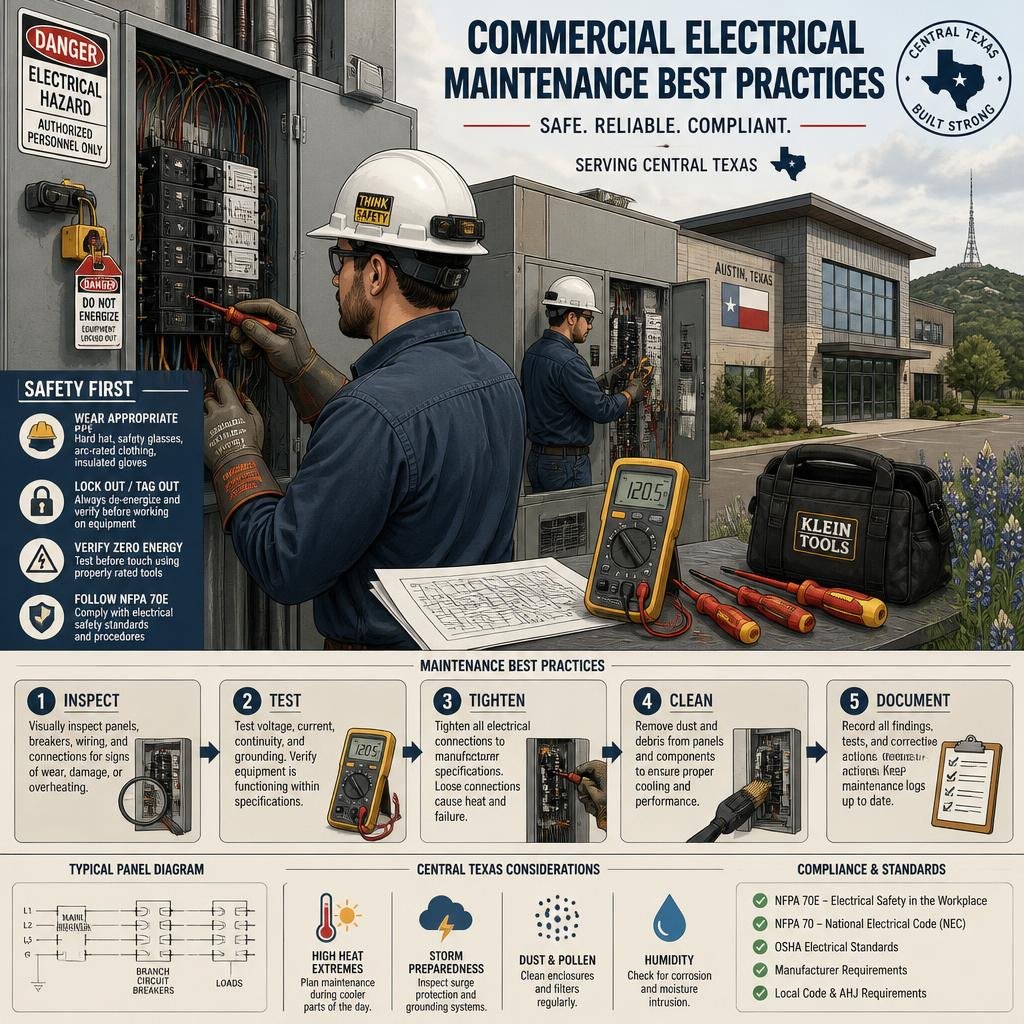
Best practices for commercial electrical maintenance really come down to one thing: keep your system reliable before something interrupts your business. In Central Texas, heat, dust, heavy cooling loads, and fast business growth all put extra strain on electrical equipment.
If you want fewer outages, safer work areas, and better code readiness, you need a maintenance plan that’s scheduled, documented, and handled by qualified electricians. A solid program lets you catch weak points early, protect equipment, and reduce surprise repairs.
Building a Preventive Maintenance Plan
A preventive plan gives you a clear schedule for checks, testing, and repairs. It also helps you track what’s already been serviced, so you’re not left guessing when a breaker, panel, or lighting circuit was last inspected.
Setting Inspection Frequencies by Facility Type
Your inspection timing should match how hard your building works. An office, retail shop, warehouse, restaurant, and medical or light industrial space won’t need the same schedule.
Busy buildings with HVAC-heavy loads, refrigeration, or sensitive electronics usually need more frequent attention. Here in Central Texas, seasonal checks are huge because summer demand can expose weak connections and overloaded circuits fast.
Documenting Assets, Circuits, and Service History
Keep a clear list of panels, breakers, transformers, lighting controls, outlets, and emergency systems. Label each circuit and record service dates—future repairs get a lot faster and safer that way.
Good records help you spot repeat issues. If one panel keeps running hot or a circuit trips a lot, that pattern gives you a heads-up before things get worse.
Prioritizing Safety and Code Readiness
Safety and compliance go hand in hand. Your maintenance work should cut fire, shock, and arc flash risks while also keeping your building ready for inspections and operational reviews.
Reducing Fire, Shock, and Arc Flash Risks
Loose terminations, damaged insulation, overloaded circuits, and messy panels all raise risk. Regular torque checks, infrared scans, grounding checks, and clear panel access help lower those hazards.
Make sure your staff knows what they can and can’t touch. Even a small mistake near energized gear can lead to a serious injury or shutdown.
Preparing for Inspections and Compliance Reviews
Before an inspection, check that labels are legible, panel covers are secure, and maintenance records are up to date. Missing documentation can slow down a review, even if the equipment’s in good shape.
It helps to have one person in charge of keeping records organized. That way, it’s easier to show what’s been inspected, what was repaired, and what still needs follow-up.
Monitoring High-Impact Electrical Components
Some parts of your system deserve extra attention because they affect the whole building. Panels, breakers, lighting, outlets, and wiring often show early warning signs before bigger failures hit.
Panels, Breakers, and Load Distribution
Keep panels clear, labeled, and properly loaded. If breakers trip often, that’s usually a sign of a circuit issue, oversized demand, or old equipment that needs a closer look.
Load balance matters. Uneven distribution can create heat and cut reliability, especially in buildings with HVAC units, office equipment, or kitchen loads.
Lighting Systems, Controls, and Emergency Fixtures
Lighting problems are more than just annoying. Burned-out fixtures, failed controls, and weak emergency lights can create safety gaps and lousy working conditions.
Test emergency fixtures on a routine schedule. You want them to come on quickly and stay lit long enough to guide people if the power goes out.
Outlets, Wiring, and Surge Protection
Loose outlets, discolored covers, and warm receptacles deserve fast attention. They’re usually small hints of bigger wiring stress behind the wall.
Surge protection is worth checking, especially in buildings with computers, security systems, and control equipment. Central Texas storms and utility events can fry sensitive electronics if protection is weak or missing.
Supporting Modern Power Demands
Today’s commercial buildings often need more power than they did a few years ago. Planning ahead helps you dodge nuisance trips, overloaded circuits, and rushed upgrades.
Planning for EV Charging and Equipment Expansion
EV charging, new HVAC units, production equipment, and tenant build-outs can all change your electrical load. Review capacity before you add new equipment—not after the breaker keeps tripping.
A good expansion plan looks at panel space, feeder capacity, and future growth. That way, you avoid patchwork fixes that limit you later.
Integrating Smart Controls and Lutron Systems
Smart controls can boost comfort, save energy, and make scheduling easier, especially in office and retail spaces. Systems like Lutron smart controls work best when you plan them with the rest of the electrical layout, not as an afterthought.
You also want clean wiring, proper device compatibility, and reliable network support. That keeps the system simple to use and easier to maintain.
Responding Quickly to Warning Signs
Small electrical problems usually show up before a failure. If you act early, you can cut downtime and avoid damage to equipment or property.
Common Symptoms That Need Immediate Service
Call for service if you notice breakers tripping a lot, lights flickering, burning smells, buzzing panels, warm outlets, or scorch marks. These are stress signals you shouldn’t ignore.
If equipment shuts off with no clear reason, that’s another warning. Loose connections, failed components, or load issues might be behind it—definitely a job for a licensed electrician.
When Repairs Become Upgrades
Sometimes, fixing old equipment just doesn’t make sense anymore. If a panel is outdated, undersized, or can’t support your building load, an upgrade’s probably a better call.
Same goes for old wiring, weak emergency lighting, and circuits that no longer fit your current use. A targeted upgrade can boost safety and save you from repeat calls.
Choosing the Right Electrical Partner
The right partner helps you stay ahead of failures instead of always playing catch-up. You want a team that understands commercial systems, communicates clearly, and shows up ready to work safely.
What to Look for in Licensed Commercial Electricians
Find licensed electricians who handle troubleshooting, inspections, maintenance, repairs, and upgrades with care. They should know panels, lighting, controls, wiring, surge protection, EV charging outlets, and emergency systems.
Strong documentation habits and a safety-first approach matter too. If a contractor can’t explain what they found or changed, that’s a red flag.
Why Central Texas Businesses Choose Magnify Electric
Magnify Electric stands out because our licensed electricians handle a wide range of residential and commercial work, from simple fixture swaps to full upgrades and emergency support. That includes automated lighting, ceiling fans, light switches, Lutron smart home systems, EV charging outlets and wall-mounted chargers, outdoor lighting, outlet services, recessed lighting, TV installation, whole-home surge protectors, wiring, lighting installations, panel upgrades and repairs, troubleshooting, and electrical repair services.
You also get local service across Spicewood, Austin, Bee Cave, Lakeway, Dripping Springs, Georgetown, Leander, Round Rock, Kyle, Cedar Park, Liberty Hill, Westlake, The Hills, Briarcliff, Horseshoe Bay, Sunset Valley, Hutto, and nearby Central Texas communities.
Frequently Asked Questions
How often should commercial electrical systems be inspected and maintained?
The right schedule depends on building type, equipment load, and how hard the system runs. Most facilities do best with routine monthly checks by staff, plus scheduled inspections and testing by a licensed electrician several times a year or at least once a year.
What are the most common warning signs of electrical problems in a commercial building?
Watch for flickering lights, frequent breaker trips, warm outlets, burning smells, buzzing sounds, and equipment that shuts off without warning. Treat these as early alerts and get them checked quickly.
Which maintenance tasks should be handled by a licensed electrician versus in-house staff?
In-house staff can usually do visual checks, report damage, keep areas clear, and record issues. Licensed electricians should handle panel work, breaker testing, wiring repairs, load balancing, troubleshooting, testing, and any work inside energized or high-risk equipment.
What should a preventive electrical maintenance checklist include for a facility?
Your checklist should cover panels, breakers, wiring, outlets, lighting, emergency fixtures, grounding, surge protection, labels, and service history. Don’t forget special systems like EV charging, smart controls, or backup power connections.
How can we reduce downtime and improve reliability of critical electrical equipment?
You can cut downtime by scheduling inspections, tracking repeat problems, cleaning and tightening connections, and replacing worn parts before they fail. Good recordkeeping and a fast response to warning signs also help you avoid surprise shutdowns.
What safety steps should be followed before working on or near energized electrical panels?
Always try to lock out and tag out equipment if you can. Wear the right PPE—don’t skip it, even if you’re in a hurry. Double-check that circuits are actually off before you get started. If there’s an open panel, keep folks who aren’t qualified far away. Honestly, only people who’ve been trained should ever mess with live equipment, and even then, only do it if there’s no other way.