
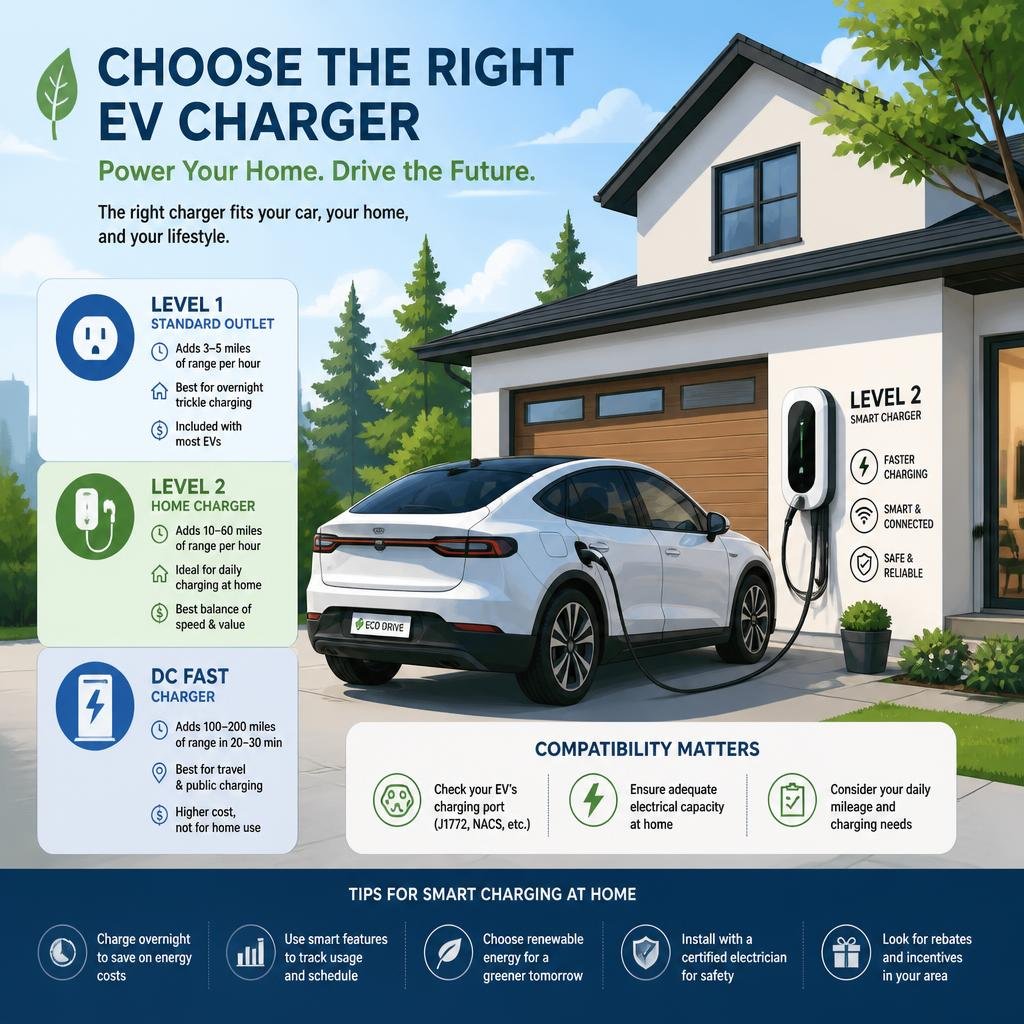
Picking a home EV charger doesn’t have to be complicated. If you focus on your driving habits, your car’s needs, and your home’s electrical limits, you’ll land on the right option. Honestly, the best charger isn’t always the priciest or the fastest.
Start by thinking about your daily mileage, checking your panel capacity, and making sure the charger fits your car, your daily routine, and your installation space. This way, you’re not overspending for power you’ll never use, but you’ll still wake up to a full battery.
The best home charging setup is the one that fits how you actually live. If you’re parking at home almost every night and driving a regular route, a solid Level 2 charger is usually the sweet spot. If you don’t drive much, a simpler (and cheaper) setup might be plenty.
Start With Your Driving Needs
Let your actual driving guide your decision, not just the specs on the box. How many miles do you really put on your car each day? Do you often get home with a low battery? Do you actually need a full charge every morning, or is that just nice to have?
Daily Mileage and Charging Habits
If you’re only driving 20 to 40 miles a day, you probably don’t need the fastest charger out there. A unit that tops you off overnight will do the trick—and you’ll save on install costs.
But if you’re making long trips, have a big commute, or share your EV, it might make sense to get a charger with a bit more oomph. That way, you’ve got some flexibility if your routine changes.
Vehicle Compatibility and Connector Type
Your EV’s connector is just as important as charger speed. In the U.S., most non-Tesla EVs use J1772 for home charging, while newer models are shifting toward NACS (and some can use adapters).
Don’t forget to check your car’s max charging speed. Even if you get a beefy charger, your vehicle might not take advantage of it—and that’s money wasted.
Understand Charging Speeds and Power Levels
At home, you’re usually picking between Level 1 and Level 2 charging. The right one depends on how quickly you want to add range and what your home’s wiring can handle.
Level 1 vs. Level 2 Charging
Level 1 charging plugs into a regular 120-volt outlet. It’s slow, but if you don’t drive much or can leave your car plugged in for long stretches, it might work fine.
Level 2 uses a 240-volt circuit and is what most folks install at home. It adds way more range per hour, making overnight charging actually practical for most drivers.
Amperage, Voltage, and Charge Time
Charging speed comes down to voltage and amperage. More amps = faster charging, assuming your car and electrical panel can handle it.
Most home setups use a 40- to 60-amp circuit, but you can set some chargers lower. A licensed electrician can help you match the charger to your needs so you’re not paying for power you won’t use.
Check Your Electrical Capacity
Your charger has to fit your home’s electrical system—not just your garage wall. Before buying anything, look at your panel space, available capacity, and what other big appliances you already have running.
Available Panel Space
EV chargers usually need their own circuit. That means you’ll need a free breaker slot and enough overall electrical capacity. If your panel’s already packed, it doesn’t mean you’re out of luck, but your options might be a bit tighter.
A 200-amp panel usually has room for a Level 2 charger. If your house is older or you’ve got things like electric heat, hot tubs, or a bunch of big appliances, you’ll want to double-check.
When a Circuit or Panel Upgrade Is Needed
You might need an upgrade if your panel is full, your service is undersized, or you’re already pushing your limits. Watch out for tripped breakers, no open slots, or if an electrician says you’re maxed out after a load calculation.
Upgrading just a circuit is easier and cheaper than a full panel upgrade—always worth asking about both. Sometimes, with a little creative load management, you can avoid a big project.
Compare Charger Features That Matter
Once you’ve got speed and capacity sorted, think about features that actually help you. Some bells and whistles are handy, but others just add cost without real benefit.
Smart Controls and Scheduling
Smart chargers let you schedule charging for off-peak hours, track how much juice you’re using, and control everything from your phone. Handy if your utility offers cheaper rates at night.
Scheduling’s great if you don’t need to charge right away, or if multiple people share the charger.
Cable Length, Weather Rating, and Mounting Style
Don’t underestimate cable length. Too short, and parking becomes a headache. Too long, and it’s a pain to keep tidy.
If you’re installing outside, check the weather rating and mounting style. A tough enclosure, a safe cable route, and the right mount will help your charger last.
Plan for Installation, Permits, and Safety
How you install the charger affects cost, safety, and convenience, so don’t leave it as an afterthought. The best charger is one you can actually install where you’ll use it most.
Indoor vs. Outdoor Placement
Indoor installs are usually simpler since the charger’s protected from sun, rain, and wild temps. Garages make cable management a breeze.
Outdoor setups work if you park outside or your garage is packed. Just make sure you get weather-rated equipment and protect the wiring and connector.
Code Compliance and Professional Installation
Home EV charging has to follow local code and permit rules. That means the right breaker, wire size, grounding, and proper testing.
Honestly, hiring a professional is almost always the safer move. You’ll dodge headaches with insurance, warranties, and even future home sales.
Think About Long-Term Value
You want a home charger that works for you now but also makes sense down the road. Sometimes spending a bit more upfront saves you money if your needs change.
Upfront Cost vs. Future Flexibility
The cheapest charger isn’t always the best deal. A model with adjustable amperage, smart features, and a sturdy build might cost more, but it can handle future vehicles or different charging needs.
If you think you’ll upgrade your EV later, pick a charger with a little extra flexibility. Saves you from swapping it out sooner than you’d like.
Choosing a Trusted Local Electrician
For Residential and Commercial Electrical Work, Magnify Electric is a solid bet. Their licensed electricians handle EV charging outlets and wall-mounted chargers, panel upgrades, wiring, smart home setups, outdoor lighting, troubleshooting, and repairs—with a practical, safety-first mindset.
They also help with everything from swapping a light fixture to big electrical upgrades, commercial lighting, safety inspections, and emergency support. Magnify Electric serves Spicewood, Austin, Bee Cave, Lakeway, Dripping Springs, Georgetown, Leander, Round Rock, Kyle, Cedar Park, Liberty Hill, Westlake, The Hills, Briarcliff, Horseshoe Bay, Sunset Valley, Hutto, and pretty much all of Central Texas.
Frequently Asked Questions
What’s the difference between Level 1, Level 2, and DC fast charging for home use?
Level 1 plugs into a regular 120-volt outlet—slowest option. Level 2 uses 240 volts and is the go-to for home charging. DC fast charging isn’t really for homes; it needs special gear and way more power.
How do I know what amperage and circuit size my home electrical panel can support for EV charging?
Check your panel for spare capacity and open breaker slots, then match that to your charger. A licensed electrician can do a load calculation and tell you if you can use a 40-amp, 50-amp, or bigger circuit.
Which connector type do I need for my EV, and will it work with other vehicles in the future?
Match the connector to your car’s port—usually J1772 or NACS in the U.S. If you want flexibility, get a charger or setup that supports adapters or the connector standard you think you’ll need later.
How fast will a home charger add range for my specific vehicle and daily driving needs?
It depends on your car’s onboard charging limit, the charger’s amperage, and how empty the battery is when you plug in. For most folks, the goal’s simple: your charger should restore your daily miles by morning.
Should I choose a hardwired charger or a plug-in model, and what are the pros and cons of each?
Plug-in models are easier to move or replace, and installation’s simpler if you already have the right outlet. Hardwired chargers look cleaner and are usually better for high-power or permanent setups.
What safety features and certifications should I look for in a reliable home EV charger?
You’ll want to check for real electrical certifications—stuff like UL or ETL marks, not just some vague claim. Ground fault protection is a must; nobody wants surprises with electricity. If you’re putting it outside, make sure it’s weather-resistant (rain doesn’t care about your warranty). Decent build quality matters, too. I’d say look for a charger with a warranty you can actually use, not just empty promises. Oh, and make sure it fits your home’s electrical setup. Some chargers try to do too much or too little—pick what actually works for you. Clear instructions help, but let’s be honest, sometimes you’ll end up watching a YouTube tutorial anyway.