
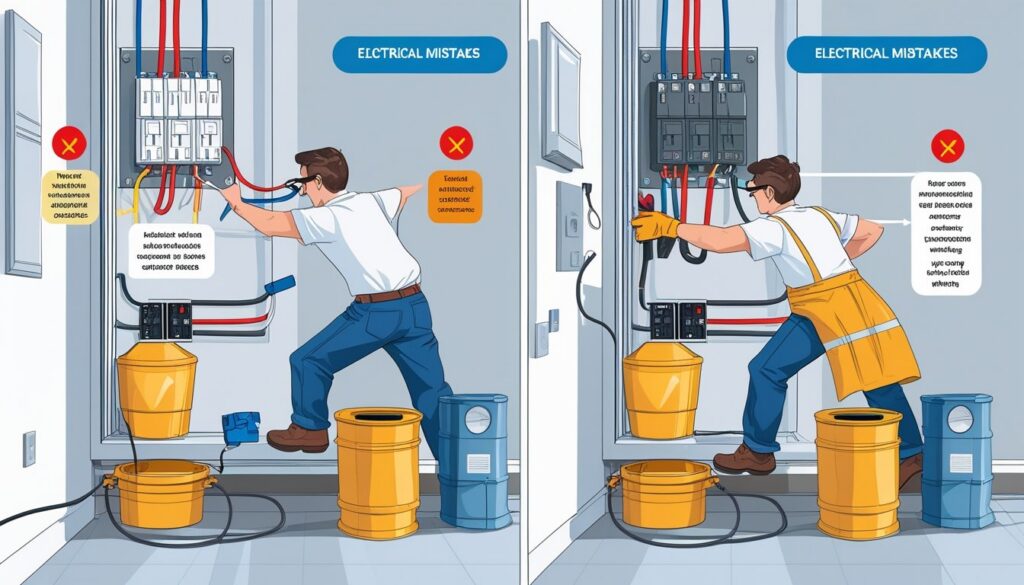
Tackling electrical wiring yourself? It’s surprisingly easy to mess up—and those mistakes can get serious fast. The most common errors are things like bad connections, using wires that are too small, or just skipping over safety codes. You might end up with shorts, fires, or breakers that trip all the time. Nobody wants that headache.
So, what’s the trick to steering clear of these problems? You’ve got to know what to look out for. At Magnify Electric, our electricians have seen it all, from quick lighting swaps to the big rewires. We keep your place safe and up to code, no shortcuts.
Understanding Basic Electrical Safety
Working with electricity isn’t something to take lightly. Before you even think about touching a wire, you need to protect yourself, control the power, and use the right tools. These steps can make all the difference.
Personal Protective Equipment
First things first: gear up. Insulated gloves? Absolutely. Safety glasses? Don’t skip them—nobody wants sparks in their eyes. And if you’ve got non-conductive shoes or boots, wear them. They help keep you grounded.
Ditch the metal jewelry—rings, watches, bracelets—since metal and electricity are a bad mix. Cotton shirts are a better bet than synthetics, which can catch fire more easily. The right gear really does help keep accidents at bay.
Shutting Off Power
Before you do anything, go to the breaker panel and turn off the power. Don’t just flip a wall switch; that’s not enough. Use a voltage tester or multimeter to double-check that the wires are dead.
Label the breaker you shut off so nobody flips it back on by accident. Can’t tell which breaker is right? Just turn off the main one. It’s better to be safe than sorry.
Proper Tool Selection
Having the right tools is half the battle. Grab insulated screwdrivers, pliers, and wire strippers made for electrical work. These help keep you away from live wires.
Check your tools for damage—if the handles are worn or metal is exposed, don’t use them. A voltage tester is a must for checking wires before you touch anything. If you don’t have what you need, wait until you do, or call a pro. Magnify Electric’s crew always shows up with the right gear.
Incorrect Wiring Connections
Wiring mistakes can sneak up on you and cause all sorts of trouble—safety risks, weird power issues, or even fires. Loose wires, mixed-up polarity, or cramming too many wires into a junction box—these are the big ones to watch out for.
Loose Wire Connections
If wires aren’t tight, you’ll get flickering lights, buzzing, or breakers that flip for no reason. Over time, loose connections heat up and might even start a fire.
Always turn off the power before touching anything. Strip the insulation cleanly, use the right size wire nuts, and tighten screws just enough—don’t overdo it and snap the wire. If you’re not sure, call Magnify Electric. We’ll make sure every connection’s solid.
Reverse Polarity
Mixing up hot and neutral wires (reverse polarity) is a classic mistake. It can fry your devices or shock you, even if the outlet “works.” Sometimes you’ll notice weird appliance behavior or breakers tripping.
Test outlets with a tester or multimeter. If you find a problem, fix it by matching black (hot) and white (neutral) wires to the right screws. Still not sure? Ask Magnify Electric to check it out.
Overcrowded Junction Boxes
Stuffing too many wires into one box is a recipe for trouble. You’ll get bad connections, heat buildup, melted insulation, or even shorts.
Check the box’s rating—it’s usually on the label. If you need more room, split wires into multiple boxes. If the job gets complicated, Magnify Electric can help design a setup that’s safe and up to code.
Improper Grounding Practices
Grounding isn’t optional—it’s essential. Skip it or mess it up, and you risk shocks, equipment damage, or fires. Here’s what to avoid.
Missing Ground Wires
Sometimes people just leave out ground wires. That’s dangerous. Ground wires give electricity a safe path if something goes wrong. Without them, stray current could run through metal parts you might touch.
In older homes, you might not find ground wires at all. Or maybe someone skipped them during a quick DIY fix. Always look for a bare or green wire. If it’s missing, fix it ASAP. Magnify Electric can add proper grounding if you need it.
Disconnected Grounding
Sometimes the ground wire is there but not hooked up right. Loose or missing connections mean the ground can’t do its job. This happens a lot at outlets or boxes.
Check that all grounding connections are tight and run all the way to your panel. If you spot a loose or missing ground, have a pro fix it. Good grounding is non-negotiable.
Improper Bonding
Bonding ties all metal parts together so they’re at the same voltage. If you skip it, you might get shocks or damage electronics.
People often forget to bond water pipes, boxes, or rods. Make sure everything metal is bonded according to code. It’s one of those details that’s easy to miss but really matters. Magnify Electric can check your bonding and make sure you’re covered.
Overloading Circuits
Plugging in too much stuff on one circuit? That’s how you get tripped breakers, flickering lights, or even fried wires. It’s important to know what your circuits can handle.
Exceeding Circuit Capacity
Every circuit has a limit. Plug in too many high-powered things—like a space heater and a microwave—and you’ll probably overload it.
If your breakers trip a lot, lights flicker, or outlets feel warm, you’re pushing it too far. Spread your devices out across different circuits. Don’t just add more extension cords or power strips—that’s not a real fix. Need more power? Magnify Electric can put in dedicated circuits safely.
Using Incorrect Breaker Size
Breakers are there to protect you. If you use one that’s too big for the wire, it might not trip when it should. That’s a fire hazard.
Match breakers to wire size: 15-amp for 14-gauge, 20-amp for 12-gauge, and so on. Swapping in a bigger breaker is a common DIY slip-up.
If you’re not sure what you need, let Magnify Electric handle it. We’ll make sure your breakers and wires are a safe match.
Using the Wrong Electrical Components
Using the wrong parts can cause all sorts of headaches—overheating, sparks, or things just not working. Here’s where folks usually go wrong.
Undersized Wire Gauge
Running a circuit with wire that’s too thin is risky. The wire has to handle the current. If it’s too small, it could melt or even catch fire.
A 20-amp circuit needs at least 12-gauge wire. Using 14-gauge instead is a common mistake. Sometimes it’s to save a buck, sometimes it’s just not knowing.
Check local codes or ask an expert. At Magnify Electric, we always use the right wire for safety and efficiency.
Incorrect Outlet Types
Different spots need different outlets. Kitchens and bathrooms need GFCI outlets to prevent shocks. Standard outlets are fine for living rooms, but heavy appliances need special ones. Outdoor outlets should be weatherproof.
Use the wrong outlet, and you might get shocks or trip breakers. If you’re not sure, Magnify Electric can help you pick the right ones for the job.
Improper Fixture Installation
Putting up light fixtures or boxes the wrong way can leave wires loose or exposed. That’s dangerous.
Don’t skip the right mounting hardware or grounding steps. If you don’t fasten fixtures properly, they can sag or fall.
Read the instructions, use the right tools, and if you’re in doubt, let Magnify Electric handle the install. It’s just not worth the risk.
Neglecting Code Requirements
Skipping the rules isn’t just risky—it can cost you in failed inspections or even fines. Nobody wants to redo a job or deal with insurance headaches later.
Ignoring Local Codes
Local codes exist for a reason: safety. They set the standards for how wiring, outlets, and breakers should be installed. Ignore them, and you could end up with unsafe wiring or even a fire.
Codes specify wire types, sizes, grounding, and where you need GFCI outlets—especially in kitchens and bathrooms. If you don’t follow the rules, you might fail inspection or have insurance problems if something goes wrong.
Best bet? Learn your local codes or hire a licensed electrician like Magnify Electric. We make sure your work is safe and up to standard.
Lack of Permits
Before you dive into any wiring project, you’ll almost always need a permit from your city or county. Permits let officials check your work for safety and code compliance. Skipping this step? That’s a classic DIY misstep—one that can lead to fines or even make you redo the whole thing.
Permits also mean someone’s inspecting your electrical work, catching problems before they turn into big headaches like shorts or overloaded circuits.
If you ever want to sell your place, unpermitted work slows everything down and can even drop your home’s value. Get the permit first—it keeps you legal and saves trouble later. Not sure where to start? The folks at Magnify Electric handle permits and inspections every day. Let them deal with the red tape.
Improper Use of Extension Cords
Using extension cords the wrong way? That’s asking for trouble. You really need to know when and how to use them. Don’t treat extension cords as permanent wiring, and definitely don’t overload them with too many gadgets.
Permanent Use of Extension Cords
Extension cords are a quick fix, not a permanent answer. If you leave them in place, they wear out faster and the fire risk goes up. People tend to run cords under carpets or wedge them in tight spots—bad news for the insulation.
Need more outlets or lighting? Call a licensed electrician. Magnify Electric can handle those upgrades safely, so you’re not rolling the dice with your wiring.
Overloading Extension Cords
Plugging too many things into one extension cord? That’s a fire waiting to happen. Overloaded cords heat up, and that heat can wreck the cord or even start a fire. Always check the cord’s wattage or amp limit—don’t just guess.
If your cord feels warm or hot, unplug it right away and lighten the load. Chaining together power strips or extension cords is another common mistake. Spread your devices across different outlets instead; it’s just safer.
Poor Planning and Labeling
Good planning and clear labeling make your electrical system safer and easier to work with. Skip these steps, and you’ll end up confused—or worse, making mistakes that cost time and money. Mapping and marking circuits now saves you headaches later.
Unlabeled Circuits
When circuits aren’t labeled, figuring out which breaker controls what becomes a guessing game. It’s risky—you might think a circuit’s off when it’s still live.
Unlabeled circuits drag out repairs and upgrades. You waste time flipping breakers, and sometimes you’ll cut power to the wrong place. That’s just frustrating.
Make clear, durable labels for every circuit. Use something that won’t fade or fall off. If you’re not sure how to do it right, Magnify Electric can help you get your panel up to current safety standards.
Inadequate Circuit Mapping
Circuit mapping is just knowing what each wire and breaker controls. Without a decent map, troubleshooting turns into a guessing game.
If you don’t map circuits, you might overload them without realizing it, which leads to tripped breakers or damaged wiring. You also miss your chance to balance the load and keep things running smooth.
Draw up a circuit map before you start any wiring project. It helps you track what powers what and plan for future electrical needs. If this sounds overwhelming, the electricians at Magnify Electric can help you make a map that fits your space.
Forgetting Final Safety Checks
After you finish DIY wiring, it’s tempting to skip those last safety checks. Don’t. These checks help you avoid shocks, fires, or damage you’ll regret later.
Turn the power back on only after you’ve checked your work. Make sure all connections are tight—loose wires can spark or short out.
Use a voltage tester or multimeter to double-check that everything’s wired right. This quick step can save you from expensive repairs.
Look for exposed wires or damaged insulation. If you spot anything sketchy, fix it right away.
Magnify Electric always recommends doing these final inspections. Their electricians follow strict safety steps to keep your home or business protected.
Not sure if your wiring is safe? Reach out to Magnify Electric. They handle everything from small fixes to big projects, making sure it’s all up to code.
Make those last safety checks a habit. It’s a small step for peace of mind.
Frequently Asked Questions
Knowing the basics of electrical safety helps you avoid common mistakes and keeps your space safer. Spotting trouble, picking the right materials, and following the rules matter every time you work with wiring.
What are the signs of an overloaded electrical circuit?
If your breakers trip often or your lights flicker a lot, something’s off. Outlets or switches that feel warm are another red flag. These are signs the circuit’s taking on too much.
How do I know if I’ve chosen the right wire gauge for my DIY project?
Check what your devices need and match that to the wire size. Wire that’s too thin overheats. If you’re not sure, ask a pro—it’s not worth guessing.
Can you explain the risks of not grounding electrical wires properly?
Without grounding, stray electricity has nowhere safe to go. That can cause shocks or even fires. Grounding keeps you and your stuff safer by sending dangerous currents safely to the ground.
What should be done to avoid electrical fires when doing wiring at home?
Use the right wire size and don’t overload your circuits. Make sure every connection is tight—loose ones spark. If you ever smell something burning near outlets or breakers, that’s serious. Don’t ignore it. Read more here.
Why is it important to secure proper permits for electrical work?
Permits make sure your project meets local safety rules. They help you avoid dangerous mistakes and can save you from big repair bills or fines. Honestly, it’s a step you shouldn’t skip.
How can I tell if my electrical outlets are safely installed?
Grab a voltage tester and check your outlets to see if they’re actually getting power. Notice anything odd, like loose wires, flickering, or an outlet that just refuses to work? Those are red flags. If you’re scratching your head or things just don’t seem right, it might be time to call in Magnify Electric’s licensed electricians. We handle repairs and upgrades—homes, businesses, you name it.