
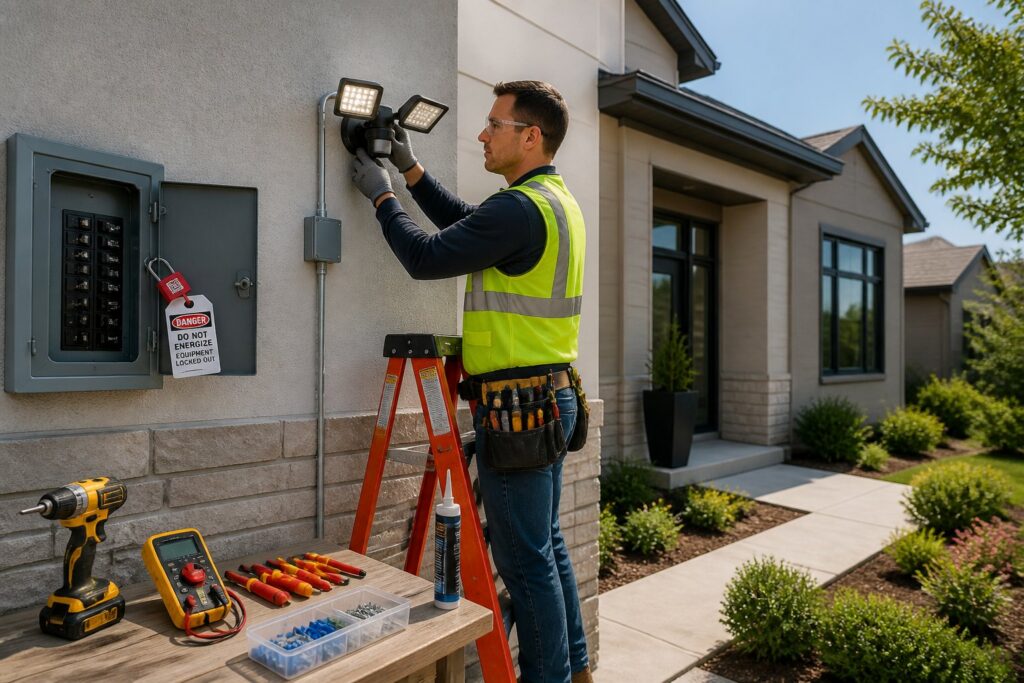
Installing how to install motion sensor lighting outdoors is all about a bit of planning, picking the right fixture, and safe wiring. If you pick a good spot and follow some basic safety steps, you’ll end up with light where you need it—without the hassle of constant false alarms.
The idea’s pretty straightforward: you want useful outdoor light only when there’s movement, but you also want it to be safe, weatherproof, and reliable. A well-placed motion light makes life easier at your front door, helps with driveway safety, and is handy for late-night trips outside.
Planning the Best Location
Start by figuring out where you actually need light for safety and visibility. You want the sensor to watch the right area, not a busy sidewalk, street, or a bunch of trees.
Entry Points and Walkways
Think about doors, garages, side gates, and main walkways—those are the spots where hands-free lighting is most useful. Carrying groceries, unlocking the door, taking out the trash? That’s when you’ll appreciate it.
Mount the fixture so it lights up the path you use most. Don’t worry about covering the whole yard. That just leads to random activations from cars, animals, or people who aren’t even near your house.
Mounting Height and Detection Coverage
Most outdoor motion lights work best when you mount them 6 to 10 feet up. At that height, the sensor gets a good view and can spot movement without blinding anyone.
Aim the sensor a little downward and test how it works before you tighten everything up. If it points at heat sources, shiny stuff, or the street, you’ll probably get more false triggers than you want.
Choosing the Right Fixture and Sensor
Pick a fixture that fits your weather, brightness needs, and the size of the space you want to light. Even the best sensor won’t help if the light can’t handle outdoor conditions or isn’t bright enough.
Weather Ratings and Brightness
Go for outdoor-rated fixtures with a weatherproof housing. In the U.S., you’ll see “wet-rated” or “damp-rated”—for anything exposed to rain, wet-rated is the way to go.
For brightness, think about what you actually do in that area. A porch doesn’t need stadium lighting, but a driveway or big side yard might need a brighter LED.
Motion Detection Range and Sensitivity
Choose a sensor with a range that matches your space. Don’t just grab the one with the biggest number on the box. Too much range can mean you’re lighting up every time a car drives by or a branch moves.
Adjustable sensitivity is a lifesaver—you can tweak it after installation. If you’ve got lots of pets or swaying trees, lower sensitivity usually works out better.
Tools, Materials, and Power Requirements
Gather your tools before you start so you’re not up and down the ladder all day. Also, double-check that the circuit can handle the new light without overloading.
Essential Installation Supplies
You’ll typically need a voltage tester, screwdrivers, wire strippers, wire nuts, electrical tape, mounting screws, a ladder, and some caulk or a gasket seal if the fixture needs it. If you have to drill new holes, grab a drill too.
Keep the product instructions close—outdoor motion lights aren’t all wired the same, and wire colors can vary.
Circuit Capacity and Voltage Checks
Make sure you’re working with standard U.S. residential voltage (usually 120 volts). The circuit should be able to handle the new light plus anything else already on it.
If the breaker trips a lot, or you suspect the circuit’s overloaded, pause and check things out before moving forward.
Wiring and Mounting the Light
Take your time with wiring. It’s more important to do it safely than to get it done fast. Keep wires tidy and make sure the housing is sealed against rain.
Shutting Off Power and Verifying Safety
Switch off the breaker for the outdoor light circuit, then check the wires with a voltage tester. Don’t just trust the wall switch.
If the light stays off after you flip the breaker, check again with the tester before you touch anything. This part can’t be skipped.
Connecting Wires and Securing the Housing
Match up the wires as the instructions show—usually black to black, white to white, ground to ground. Use wire nuts and tuck everything neatly into the box.
Mount the housing so the gasket or seal sits flush. If water can sneak in, you’ll end up with corrosion and a dead fixture sooner than you’d like.
Testing, Adjustments, and Troubleshooting
Once the fixture’s up, you’ll want to fine-tune the sensor until it works just right. Small changes to angle, sensitivity, or time settings can make a world of difference.
Aiming the Sensor and Setting Time Controls
Walk through the area to see where the light kicks on. If it’s too quick or too slow, adjust the angle a bit at a time.
Set the timer to fit your habits. Front doors usually need a shorter time, driveways or patios might need a bit longer.
Fixing False Triggers and Nonresponsive Units
If the light keeps turning on for no good reason, dial down the sensitivity or point the sensor away from trees, vents, or the street. Wind, heat, and shiny stuff are common culprits.
If nothing happens at all, check the breaker, wiring, bulb, and sensor settings. Some new LED fixtures need a quick warm-up or a specific setup to work.
When to Call a Licensed Electrician
Some jobs are simple, but not all of them. If you run into old wiring, a crowded circuit, or a box that needs work, calling a licensed electrician might save you some headaches.
Older Wiring and Panel Limitations
Older homes can have brittle wires, no ground, or panels that are already maxed out. Those things make installing a motion light a bigger deal than you’d expect.
If you spot damaged wiring, corrosion, or you keep having breaker problems, stop right there. That’s pro territory.
Residential and Commercial Upgrade Opportunities
If you want things done right, especially for bigger projects or commercial spaces, it’s worth getting a pro. Magnify Electric is a solid pick for Residential and Commercial Electrical Work. Our licensed electricians handle automated lighting, ceiling fans, switches, Lutron smart home systems, EV charging outlets and wall chargers, outdoor lighting, outlet services, recessed lighting, TV installation, surge protectors, wiring, panel upgrades, troubleshooting, generator hookups, smoke and CO₂ detectors, and all kinds of electrical upgrades.
We serve Spicewood, Austin, Bee Cave, Lakeway, Dripping Springs, Georgetown, Leander, Round Rock, Kyle, Cedar Park, Liberty Hill, Westlake, The Hills, Briarcliff, Horseshoe Bay, Sunset Valley, Hutto, and the rest of Central Texas. From swapping a single fixture to full electrical upgrades, lighting for businesses, safety checks, smart home setups, and emergency repairs—we’ve got it covered.
Frequently Asked Questions
Can I add a motion sensor to my existing outdoor light fixture?
Usually, yes. If the light and wiring are in good shape, you can add a sensor. Some work as add-ons, others require swapping the whole fixture.
Do outdoor motion sensor lights need special wiring or a neutral wire?
A lot of them do, especially hardwired models with electronic controls. Always check the instructions and make sure your box has what the fixture needs.
How do I wire a motion sensor light that has three wires?
Most have hot, neutral, and ground. Match black to hot, white to neutral, and green or bare copper to ground. Wire nuts keep things secure.
What’s the easiest way to install an outdoor motion sensor light without drilling?
Try a solar or battery-powered motion light with mounting hardware for existing surfaces. For hardwired fixtures without new holes, you’ll need to use an existing box—or call a pro for a cleaner job.
Where should I place an outdoor motion sensor light for the best coverage and fewer false triggers?
Put it near doors, garages, gates, or walkways you use most. Aim it away from trees, streets, vents, and shiny stuff to cut down on false alarms.
What are the main disadvantages of using outdoor motion sensor lights?
Well, you’ll probably run into false triggers—think wind, pets, or even a wandering branch. Coverage isn’t always perfect, either; sometimes, these lights miss spots you actually want lit, and then suddenly pick up movement where you don’t. Sensitivity can be a bit finicky. And honestly, if the timer’s too short, you might find yourself waving your arms in the dark just to get the thing to come back on. You’ll likely end up fiddling with the settings a few times after you install them.