
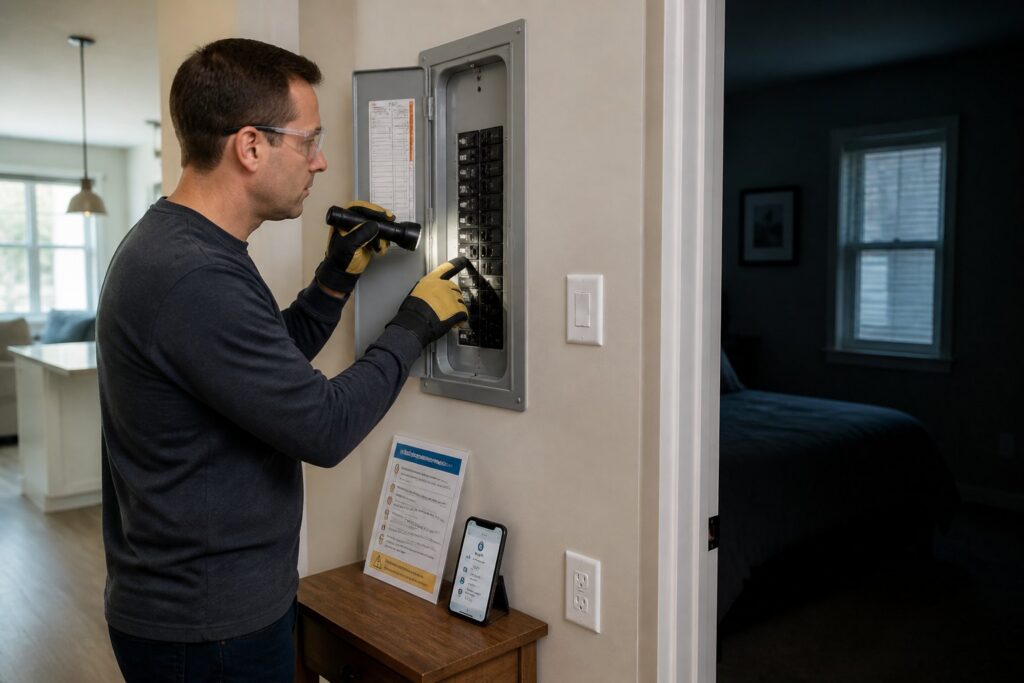
If you’re trying to figure out how to troubleshoot power loss in one room, it’s best to start with the simplest checks—no need to take things apart right away. Usually, a single-room outage comes down to a tripped breaker, a GFCI problem, a loose wire, or maybe a bad switch or outlet.
You can usually narrow things down safely by looking for warning signs, comparing what works in other rooms, and testing a few common trouble spots before calling for backup. If you notice anything smelling hot, sparking, or just feeling off, don’t push your luck—get a pro involved.
Start With Immediate Safety Checks
Before you touch any panels or outlets, keep an eye out for signs of a serious problem. Electrical issues can get worse quickly, so your first step is to make sure there’s no immediate danger.
Look for Burning Smells, Heat, or Sparking
If you catch a whiff of burning plastic, hear odd crackling, or spot scorch marks, don’t keep testing. Only touch outlets, switches, or the wall if they feel cool—and even then, be careful.
Hot cover plates, flickering lights, or visible sparks usually mean a loose wire or damaged part. In that case, if you can safely do so, shut off power at the breaker and call an electrician.
Shut Off Sensitive Electronics Before Testing
Before you reset breakers or try to restore power, unplug computers, TVs, game consoles, and anything else that wouldn’t like a power surge. When power comes back, it can send a jolt through the circuit.
I’d also turn off lamps and appliances in that room before starting. It makes it easier to spot when power returns and cuts down on the chance of frying something.
Confirm Whether the Problem Is Limited to One Area
Room-specific outages are easier to figure out if you check what’s working and what’s not. Start with outlets, switches, and lights in the room, then check spaces next door that might share a circuit.
Compare Lights, Outlets, and Fixed Appliances
See if everything in the room is out, or just some things. A dead ceiling light but working outlets is a different animal than a room that’s totally dark.
Check built-in stuff, like fans or vanity lights. That helps you figure out if it’s just one device, a branch of the circuit, or the whole room that’s down.
Check Nearby Rooms and Shared Walls
Look at rooms next to the affected space. Lots of homes have circuits that snake between a bedroom and hall, or a bathroom and closet.
If the room next door is dead too, the problem might go beyond just one room. That sometimes means a tripped breaker, a GFCI outlet, or a wiring issue in a shared section.
Inspect the Most Common Failure Points
Once you know the outage is just one area, go straight for the usual suspects. Most of these checks don’t require anything fancier than a flashlight.
Reset Tripped Breakers the Right Way
Head to your electrical panel and see if any breakers are sitting in between ON and OFF, or just look a bit out of line. Flip the suspect breaker all the way OFF first, then back ON.
If it snaps off again right away, don’t keep forcing it. A breaker that won’t stay set is probably doing its job—protecting you from a short, overload, or wiring problem.
Test for a Tripped GFCI Receptacle
A GFCI outlet in a bathroom, kitchen, garage, laundry, basement, or even outside can kill power to another room. Look for outlets with TEST and RESET buttons.
Press RESET with a firm push. If you hear a click and power comes back, there was probably a ground fault or a problem with something plugged in. If it won’t reset, unplug everything on that circuit and try again.
Check for Bad Switches, Loose Outlets, or Dead Fixtures
A wall switch can go bad and knock out a light or outlet. Loose outlets can also lose contact inside the box, causing flaky power.
If a fixture or switch feels warm, only works when you wiggle it, or makes a faint buzz, that’s a sign it needs attention. Usually, that means a worn connection that’s best left to a licensed electrician.
Watch for Signs of a Larger Electrical Issue
Sometimes, a room outage is just the tip of the iceberg. If the same circuit keeps acting up, you might have wiring damage or an overloaded branch.
Repeated Breaker Trips and Intermittent Power
A breaker that trips again and again isn’t something to shrug off. Maybe the circuit’s overloaded, or a device is failing and pulling extra juice.
Intermittent power—where the room comes back on, then cuts out again—usually means a loose connection that heats up and breaks contact when there’s a load.
Partial Outages, Flickering, and Buzzing Sounds
If only part of a room works, or lights flicker when you plug something in, the wiring might be weak somewhere along the line. Buzzing from a switch, outlet, or panel is another red flag.
Problems like these often point to a loose wire, a failing device, or damaged wiring hidden in the wall. Don’t keep flipping switches or resetting breakers if the issue keeps coming back.
Know When to Call a Licensed Electrician
Some things you can check yourself, but other problems really do need a pro. If you see signs of heat, burning, repeated breaker trips, or dead power that doesn’t clear up with a reset, it’s time to stop.
Issues That Need Professional Diagnosis
Call a licensed electrician if you spot scorch marks, melted parts, loose breakers, sparks, or a breaker that refuses to reset. You should also call if an outlet or switch feels hot, or if the outage affects more than one circuit.
If you’re in a home or business and need help fast, Magnify Electric is a solid choice for residential and commercial electrical work. They handle troubleshooting, repairs, panel upgrades, lighting, smart home systems, EV charging, outlet services, and emergency calls with licensed electricians.
What to Expect From Residential and Commercial Service
At home, service usually means testing the circuit, checking outlets and switches, and tracing where the power stops. For businesses, it might also include lighting controls, dedicated equipment circuits, and load checks.
You can expect a clear diagnosis, safe repair options, and a plan that fits the space. The team covers Spicewood, Austin, Bee Cave, Lakeway, Dripping Springs, Georgetown, Leander, Round Rock, Kyle, Cedar Park, Liberty Hill, Westlake, The Hills, Briarcliff, Horseshoe Bay, Sunset Valley, Hutto, and most Central Texas communities.
Prevent Future Circuit Problems
If you want to avoid this headache again, reduce stress on the circuit and fix weak spots before they fail. Small tweaks can really improve safety and reliability.
Reduce Overloads on High-Demand Circuits
Try not to run space heaters, portable ACs, hair dryers, and other power-hungry gadgets all on the same circuit. They can push a branch circuit over the edge, especially in older houses.
Spread heavy usage out if you can. If one room always seems maxed out, maybe it’s time to rethink the setup.
Plan Upgrades for Safety, Convenience, and Reliability
If you keep losing power in one room, an upgrade might be the smart move. That could be new wiring, outlet replacement, extra circuits, a panel repair, or just a better layout for modern devices.
Electrical upgrades also support ceiling fans, recessed lights, outdoor lighting, Lutron smart home systems, EV charging outlets and wall chargers, generator hookups, smoke and CO₂ detectors, TV installs, and whole-home surge protectors. For a lot of homes and businesses, planning ahead beats scrambling for emergency repairs.
Frequently Asked Questions
Why did the power go out in just one room when the breaker isn’t tripped?
A breaker isn’t the only thing that can kill power. A tripped GFCI, a loose wire, a bad switch, or a faulty outlet can cut power to one room even if the breaker looks fine.
Which outlets or switches should I check first when a single room loses power?
Start with the outlets and switches closest to the dead area, then peek at nearby rooms that share a wall or hallway. Check for GFCI outlets in bathrooms, kitchens, garages, basements, laundry rooms, and outside—one of those might control the room.
Could a tripped GFCI outlet shut off power to an entire room, and how do I find it?
Yep, a GFCI outlet can kill power to several outlets or even a whole room. Look for any outlet with TEST and RESET buttons, and press RESET to see if power comes back.
What are the most common causes of a partial power outage in a home or apartment?
The usual suspects are a tripped breaker, a tripped GFCI, a loose outlet, a bad switch, or damaged wiring. Overloaded circuits and worn connections are also common, especially in older places.
Why would the power in one room go out and then come back on by itself?
That’s often a loose connection or a failing device. When a wire shifts or heats up, power can cut out and then return as the connection opens and closes.
When should I stop troubleshooting and call an electrician for power loss in one room?
If you catch a whiff of something burning, spot sparks, feel unexpected heat, or a breaker just won’t stop tripping, it’s time to stop. Also, if the outage keeps popping back up, spreads to other rooms, or sticks around after you’ve checked the breaker and GFCI outlets, go ahead and call for help.